Jentic Tech Talk
The newsletter for teams building AI that actually ships. Covering APIs, AI agents, open standards, and enterprise architecture.
Introducing Jentic Mini
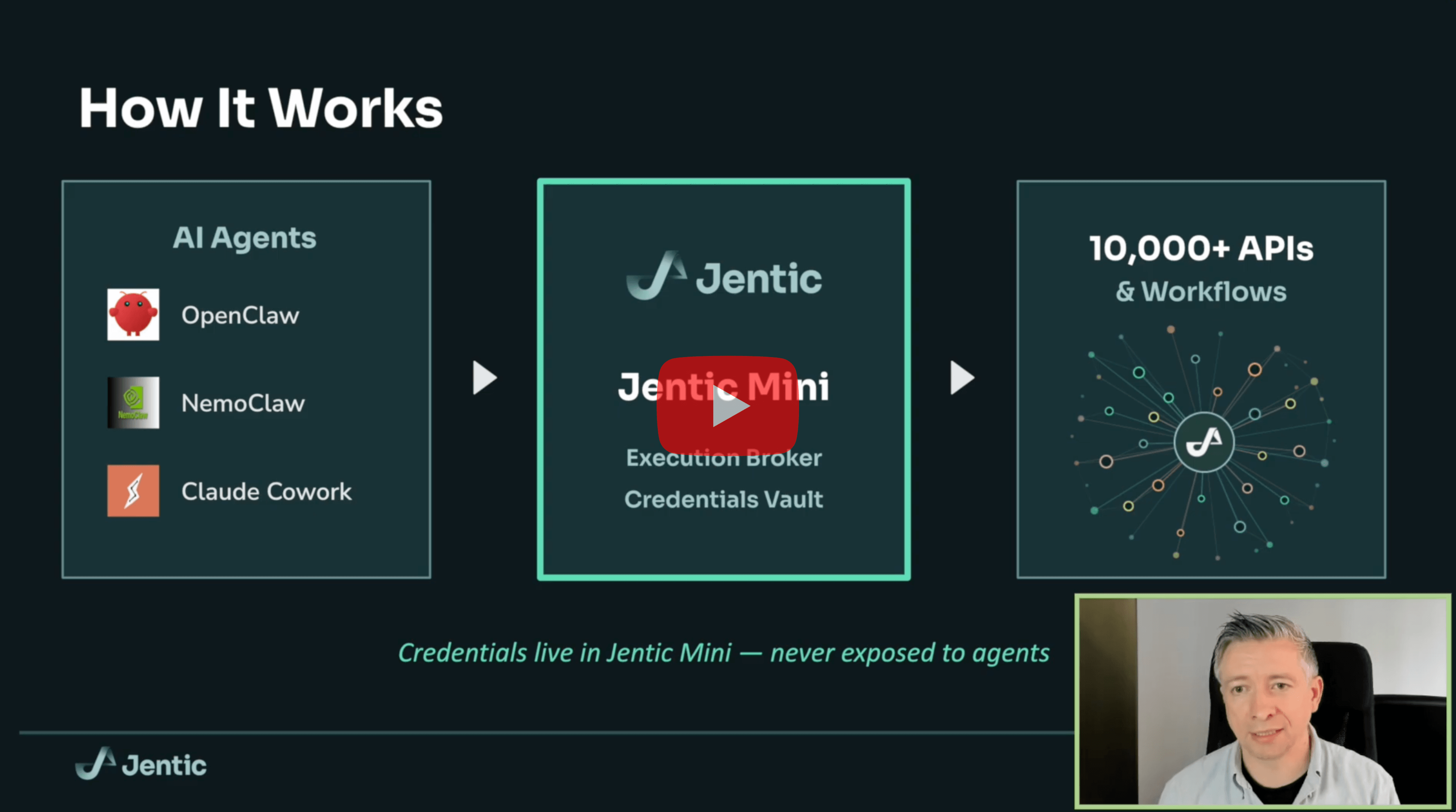
You may have seen that yesterday we launched Jentic Mini. Here is a clip of Frank explaining what it is, how it works, and how to get started.
— An Update from Erik

Erik Wilde
Head of Enterprise Strategy
From MCP to Scale: Anchoring AI Enablement in API Landscapes
MCP makes it easy to connect models to APIs. That's progress. But in larger organizations, exposing more tools is not the same as scaling AI. I explored why many AI initiatives stall after promising pilots at the iSAQB Software Architecture Gathering 2025. The issue is rarely the model — it's architecture. Scaling AI tends to follow a familiar path: improve descriptions, enable discovery, abstract recurring patterns into deterministic workflows, and introduce safe, observable execution environments. AI enablement at scale is not primarily a model problem. It's an API architecture problem.
Standards-Driven by Design: Jentic and the OpenAPI Initiative
Jentic is built on open standards. That's not just a technical choice — it's a strategic one. We actively engage with the community to help move these standards forward through the OpenAPI Initiative. Coming up next, look for the OAI Track at apidays events in Singapore (April 14–15), New York (May 13–14), Amsterdam (June 9–10), and Munich (July 8–9). If you're attending any of these, come say hello.
— An Update from Frank

Frank Kilcommins
Head of Enterprise Architecture
You May Have OpenAPI, But Is It AI-Ready?
Valid OpenAPI doesn't mean AI-usable OpenAPI. APIs that work for human developers often break when consumed autonomously by AI agents — ambiguous schemas, under-specified authentication, missing examples, inconsistent error responses. I presented this at API Days Paris and Developer Week San Jose, covering why syntactic validity isn't enough, what AI agents actually need, and how to systematically measure API AI-readiness using our open source framework evaluating APIs across six dimensions.
Arazzo UI — Visualize Multi-Step API Workflows
Arazzo workflows encode orchestration logic—step dependencies, conditional branching, retry handlers, runtime expressions. Parsing 300 lines of YAML to understand execution flow isn't productive. Arazzo UI renders workflow documents as sequence diagrams, flow charts, and documentation. It's open-source, browser-based, with no configuration required. Share workflows via URL or visualize them before AI agents execute them.
— Webinar Series
Hosted by Frank & Erik
Register for the latest webinars on APIs, agents, and what it takes to move from pilot to production.
OpenClaw & Universal Agents
Discover why APIs built for humans struggle with AI consumers—and how to assess your API estate for AI-readiness. Learn the six critical dimensions to future-proof your APIs for the agentic era.
Watch Recording →
Agent Skills, MCP & Workflows
As agents take on broader responsibilities, learn the three complementary approaches—Skills, MCP, and Workflows—that separate production-ready agents from one-off experiments.
Watch Recording →